
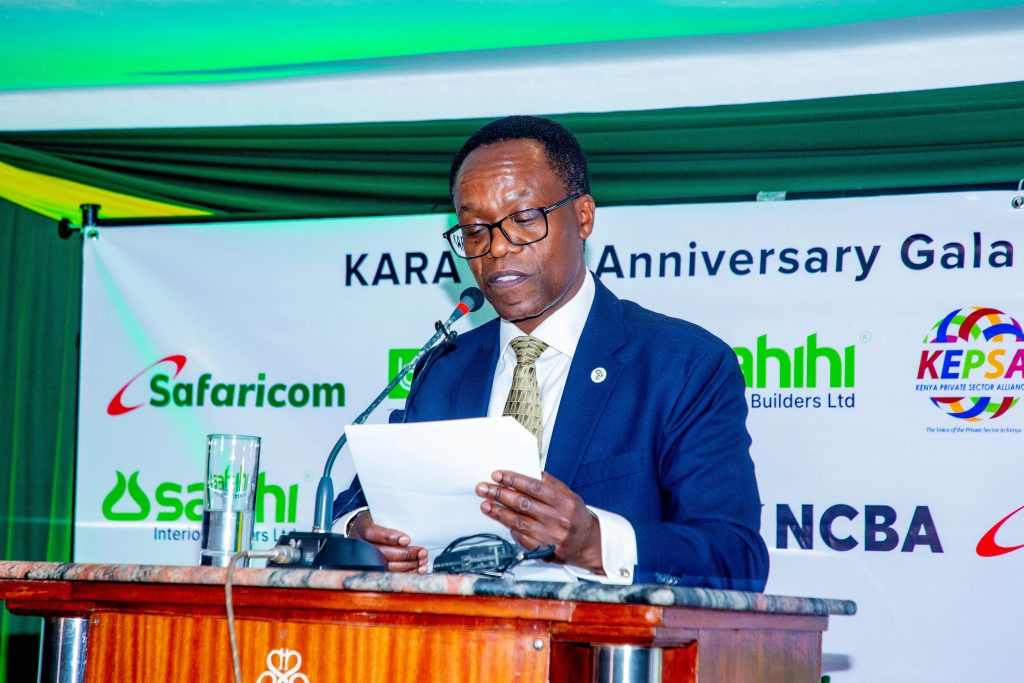
SPEAKING NOTES FOR NCBA GROUP MANAGING DIRECTOR JOHN GACHORA
It is my pleasure to be the Chief Guest at The Kenya Alliance of Resident Associations’ 25th Anniversary Gala Dinner, to celebrate a journey of promoting good governance, sustainable urban development, and community empowerment.
- For us, at NCBA, we are always delighted to be involved in thought leadership conversations. And this is a very exciting one because it speaks to all of us – the desire or aspiration to be in: safer, cleaner, and more inclusive cities and neighborhoods.
- Twenty-five years is no small feat. Since your inception in the year 2000, KARA has evolved from a few concerned neighbors to representing over 400 registered Resident Associations across the Republic.
- Tonight, I speak to you wearing multiple hats:
- One – As a chairman of my neighborhood residents’ association, I am looking forward to learning how other associations are dealing with the myriad challenges facing our neighborhoods today
- Two, As the CEO of NCBA, the solution provider to all your personal and association financial needs. With a mission to make customer lives easier, NCBA is committed to serve KARA and other customers in a sector that promotes sustainable urbanization and raises awareness on the challenges and opportunities in our cities.
Ladies and gentlemen,
- Africa’s urban centers are expanding at an unprecedented pace with estimated growth of 3.5 per cent per year.
- By 2050, these cities are projected to welcome nearly a billion new residents, presenting tremendous opportunities and significant challenges.
- While thinking about African urbanization, I thought the book titles of one Chinua Achebe aptly capture our challenges.
- Chinua Achebe wrote many books, but let me quote three: Things Fall Apart (1958), No Longer at Ease (1960) and A Man of the People.
- The book “Things Fall Apart”, centers on a man called Okonkwo, son of Unoka, and the Igbo native culture, in an attempt to demonstrate the effects colonization has on an area. Achebe portrays a rich and complex culture that is the backbone to Okonkwo’s society until colonization ultimately wipes out that culture in favor of a more western culture.
- The title of the book “Things Fall Apart” was inspired by the poem aptly names “The Second Coming” by William Butler Yeats. Allow me to read the first stanza of the poem:
- Turning and turning in the widening gyre
- The falcon cannot hear the falconer;
- Things fall apart; the centre cannot hold;
- Mere anarchy is loosed upon the world,
- The blood-dimmed tide is loosed, and everywhere
- The ceremony of innocence is drowned;
- The best lack all conviction, while the worst
- Are full of passionate intensity.
Ladies and gentlemen,
- While cities serve as engines of economic progress, they often develop in ways that exclude large segments of their populations. Mere anarchy is loosened upon the world
- In Kenya, for instance, the rate of urbanization is now at an estimated 4 per cent, heightening the need for well-planned and adequately financed urban systems. The centre cannot hold
- We see high-rises springing up in low-density estates, straining sewer lines and causing traffic gridlock. Things Fall Apart.
- Many Kenyans are forced to privately fund access roads and streetlights because the public infrastructure has not kept pace. The centre cannot hold.
- Water scarcity forces estates to drill boreholes, while waste management remains a logistical and environmental headache. We are No Longer At Ease!
- We the residents are left to fight on our own, while hungry developers and unlicensed hawkers build their fortunes. The best lack all conviction, while the worst are full of passionate intensity.
- In simple words, Ladies and gentlemen, Things Fall Apart! We are no longer at ease!
- Yet, with a growing population, a growing sophistication and a growing middle class, sustainable urban development is an absolute necessity.
- And this is where Resident Associations come in.
Ladies and gentlemen,
- Given this scenario, how do we as the Kenya Alliance of Resident Associations – KARA
– add value to the Kenyan citizen?
- In the last decade, Government funding has not been able to satisfy our neighborhood, County and National urbanization agenda.
- For areas where municipal services are lacking, organizations like KARA have played a crucial role in ensuring the efficient collection of waste, secure crime free residential areas and the maintenance of road infrastructure.
- Furthermore, the Residents Associations play a crucial role in checking the unwanted development – ensuring that residents have a voice in planning and approval. In other words, again in words of our poem – The best who lack all conviction, regain it, while the worst who are full of passionate intensity, are checked.
- However, KARA’s efforts alone in driving good governance and improved service delivery may not be enough to handle our ever-evolving urbanization needs.
- The same goes for the Government and the Private sector.
- We will all need to weave our efforts together.
- My challenge today is to the partners in the room.
- Acknowledging the significant gaps in this urbanization journey – infrastructure financing deficit, uncontrolled developments, corrupt approvals, safety and security concerns and so on, we must ask ourselves the hard questions.
- What role can I or my business play in shaping the future of the place I call home?
Unlocking Sustainable Urban Growth through collaborative efforts
- Achieving resilient, equitable, and sustainable metropolitan development requires a rigorous re-conceptualization of public-private synergy.
- The Government of Kenya has adopted the PPP model as the preferred mechanism for major projects. I believe this is a model we can extend to everything else that we do and especially in advancing the work that residents associations do:
- First, private sector are indeed residents in their own right, and certainly for our fellow employees and colleagues. Thus it is important for the private sector to partner with residents associations to enhance security in our neighbourhoods, build better roads and advance better planning for all
- Second, Working with communities through the residents associations, private sector can fund important improvements, such as water, energy and provide facilitation and capacity for residents associations to meet, plan and execute.
- The private sector offers a powerful vehicle for pooling financial resources, fostering innovation, building people capacity and evaluating resource utilization to speed up the move towards efficient urban centres.
- Private sector strategies must align not just with national development priorities but also with the needs of the community they serve and live in, to mobilize resources and strategic expertise, necessitating a synergistic relationship between public policy and private enterprise to achieve inclusive and greener urban growth.
- Post my debrief session with Henry the CEO of KARA, I picked up some NCBA solutions that can help meet the urbanization challenges we are faced with;
- Our partnership with Zetu Innovations offers Nyumba Zetu; a digital solution that automates service charge collection.
- Our Solar PV Leasing solution offers lease tenors of 7 to 10 years allowing our clients to install solar infrastructure with minimal upfront costs.
- To address water scarcity, we have partnered with Water.org to provide specialized financing for boreholes, water storage, and distribution systems.
- Through our NCBA Easy Build product, we provide a design-to-build service that includes 100% financing and access to vetted professionals to ensure that construction is professional, compliant, and dignified.
- Through our Change The Story sustainability agenda we have promised to grow over 30 million trees by 2030, and primarily by partnering with a community and residents associations to provide seedlings during tree planting season.
Ladies and Gentlemen, as I conclude
- I also ask that we encourage local businesses to make their shared spaces better for everybody, starting with small, smart changes, such as more benches, cleaner streets, and more trees, to change the vibrancy of their residency.
- A city is not just a map drawn by planners. It is a living, breathing ecosystem.
- And it gets its energy, its creativity, and its life from the people and the businesses inside it.
- So that leaves us with one last thing to think about – Next time you’re walking around your own neighborhood, your own city, look around. And ask What role can I play in shaping the future of the place I call home?
- What can I do to catch those things that are falling apart? How do I ensure that the enemies of sustainable development are No longer at Ease? How do I make the centre hold?
- Let’s start now, with what we have, and where we are. To end with Chinua Achebe’s quote: If you find water rising up to your ankle, that’s the time to do something about it, not when it’s around your neck.
Thankyou,Ladies and Gentlemen
-END-
Speech Video Link : https://www.youtube.com/watch?v=6kEMF8eEcLo&t=28s